Banking and payment processing have become hard work for a lot of international businesses. Fintech firms, online service providers, proprietary trading groups, software companies, iGaming operators, crypto businesses and anyone moving high volumes across borders tend to hit the same wall: opening accounts, getting approved by acquirers, and keeping payment flows running without interruption.
A Cyprus company is one of the more practical ways around that. Used as part of a wider operational and payment structure, it can open the door to European payment providers, tidy up how a group runs day to day, and give banks and counterparties more confidence in who they are dealing with.
Why Cyprus?
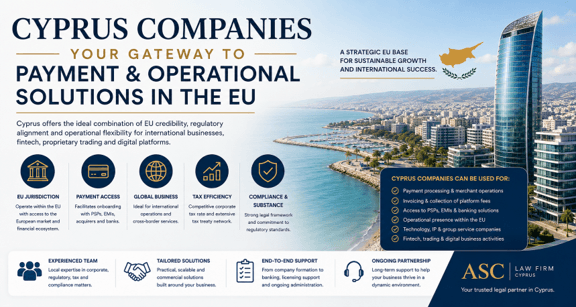
Cyprus has spent years building a reputation as an international business and fintech base. It is an EU member with full access to the European financial system, it has a mature legal and corporate framework, competitive tax, a wide double tax treaty network, and a deep professional services sector that already understands payment and technology businesses.
Because it is an EU jurisdiction, banks, Electronic Money Institutions (EMIs), Payment Service Providers (PSPs), acquirers and trading partners usually take a Cyprus company more seriously than one set up in a typical offshore location.
Common Uses of a Cyprus Entity
Payment & Merchant Operations
In a payment structure, the Cyprus company usually sits at the centre. It can be the entity that contracts with payment providers, the one customers actually pay, the company that issues invoices, or the vehicle that collects platform fees and subscriptions and coordinates how money moves across the group.
This setup is most common with SaaS products, fintech platforms, online marketplaces, proprietary trading firms, digital service providers, affiliate businesses and international technology groups.
Access to European Banking & Payment Infrastructure
Plenty of international businesses struggle to open accounts or secure processing, usually because of how their jurisdiction is perceived, bank de-risking policies, a high-risk industry label, or thin operational substance. A Cyprus company gives you a stronger base to work from. From there it becomes more realistic to pursue EMI and PSP onboarding, merchant account applications, IBANs, card processing and cross-border settlement.
Operational & Commercial Presence within the EU
A Cyprus entity also gives a group a real EU footprint: local management and substance, commercial credibility, contractual flexibility, and easier access to European counterparties. For many businesses that is simply a more practical and scalable way to run European operations.
Group Service & Technology Company
Cyprus companies are not only used at the payment layer. They often serve as technology and IP holding companies, group service providers, or licensing and operational support centres, handling work such as software licensing, platform management, customer support, marketing, compliance coordination or group treasury.
Important Regulatory Considerations
The advantages are real, but what the company actually does matters more than how it is set up. Depending on the business model, certain activities pull a company into a licensing or regulatory regime, including under:
- payment services legislation (PSD2);
- electronic money regulations;
- MiCA and crypto-asset regulations;
- investment services legislation;
- AML and compliance frameworks;
- or other EU financial regulatory regimes.
The risk is highest where a company:
- receives or controls client funds;
- processes payments on behalf of third parties;
- operates wallets or stored-value systems;
- facilitates transfers;
- or provides regulated financial services.
So it is the activity, not the incorporation, that decides whether a licence is needed. Get proper legal and regulatory advice before you build the structure, not after.
Substance & Compliance
Substance is no longer optional. Banks, EMIs and payment providers want to see a company that genuinely operates rather than a shell. Depending on the size and type of business, that can mean Cyprus-based directors, a local office, accounting and audit, working AML and KYC procedures, and real day-to-day management.
Before they onboard anyone, these providers increasingly look at economic substance, the commercial rationale for the structure, transaction flows, source of funds, and whether the operation is legitimate.
How We Assist
At ASC Law Firm we work with international businesses, fintech companies, proprietary trading groups, technology platforms and entrepreneurs across the full setup:
- Cyprus company incorporation;
- payment and operational structuring;
- EMI and PSP onboarding support;
- legal and regulatory assessment;
- substance and governance arrangements;
- tax and corporate structuring;
- AML and compliance frameworks;
- and ongoing corporate administration.
The aim is always the same: a structure that is practical, commercially workable and compliant, built around how the business actually runs. To talk through a Cyprus payment or operational structure, contact our team.